

Project Period: March 2025-October 2026
Reporting Period: July 2025 – June 2026
Project Location: Noakhali District (Hatiya Upazila)
Financial Partner: UNFPA
Project Staff: 02 (Male)
Target Beneficiaries: Adolescent girls aged 10-19 years from Hatiya Upazila of Noakhali; School going adolescent and their families, community, traditional and religious leaders and other influence of the respective community
Goal: To ensure more than 9000 adolescent girls to successfully complete secondary education up to Class 10 by fostering a safe, inclusive, and protective social ecosystem. This mission is pursued through a multidimensional approach that integrates “soft-skill” empowerment via Comprehensive Life Skills Education (CLSE) with “hard-skill” investments in school infrastructure and essential health services.
Major Activities
Orientation on Gender Equality and GBV Prevention for Adolescents and Youth
In 2025, a specialized one-day orientation program was organized in Hatiya Upazila to enhance awareness among adolescents regarding gender-based discrimination and protection. The primary goal of this initiative was to equip participants with the tools to identify and prevent Gender-Based Violence (GBV) while ensuring social safety within their communities.
The sessions provided detailed insights into fundamental rights, the severe consequences of child marriage, and the available legal and social support mechanisms including helplines for addressing violence.The orientation reached 25 participants, including 19 adolescent girls and 6 boys. This intervention resulted in a clear understanding of gender equality and protection strategies among the youth. The strong participation of 19 girls is expected to have a significant impact on women’s empowerment and leadership development in the region. Furthermore, the inclusion of boys ensures that young men are becoming equally responsible stakeholders in preventing violence. In the long term, this heightened awareness will serve as a critical deterrent against child marriage, helping to build a secure and violence-free society in Hatiya.
Interactive Sessions on Life Skills Education (LSE)
A central pillar of the intervention was the systematic delivery of 1,170 sessions in 2025 and 780 sessions in 2026 utilizing the Gender Equity Movement in Schools (GEMS) curriculum. These sessions empowered 8,719 students including 5,773 girls and 2,946 boys in 2025 and 6,926 students including 4,124 girls and 2,802 boys in 2026 with critical knowledge on gender equality, bodily autonomy and reproductive rights. By prioritizing inclusivity, the program successfully integrated 16 students (male 05, female 11) with disabilities into these life-saving lessons.
The sessions significantly improved teacher-student communication, enabling adolescents to openly discuss physical and mental health issues and better understand puberty-related changes. By engaging both boys and girls, the program addressed harmful gender norms and promoted respectful peer relationships. Teachers have also reported early signs of child marriage cases. Despite disruptions caused by school strikes, all annual targets were achieved accordingly, contributing to long-term progress toward the Women, Peace and Security agenda.
Shahana Cartoon Quiz Competition and Prize Giving Ceremony
To engage the adolescent of Hatiya through innovative communication, an “edutainment” model was implemented across 30 educational institutions. By utilizing the Shahana cartoon series, a recognized tool for social change the initiative delivered sensitive messages regarding bodily autonomy, consent, and the dangers of early marriage in a format that resonated with adolescents. The program reached a total of 9,327 students (6,115 girls and 3,212 boys). Implementation followed a rigorous three-phase approach: a collective screening of the series, a formal written quiz to test comprehension of legal protections and gender equality, and a prize-giving ceremony.
A total of 750 top achievers were recognized, effectively transforming them into “peer advocates” within their villages. This visual storytelling method proved highly effective in dismantling complex social stigmas, as students demonstrated a clear grasp of their rights and the negative consequences of gender-based violence. The activity not only reinforced key learning objectives but also solidified a unified institutional commitment to fostering a generation that actively champions an equitable and safe social environment.
Construction of Adolescent Friendly Health Space (AFHS) in 250-Bedded General Hospital, Noakhali
In 2025, an Adolescent Friendly Health Space (AFHS) was established at the 250 Bedded General Hospital in Noakhali. The facility helps Rohingya and vulnerable host-community adolescents who often avoid Sexual and Reproductive Health and Rights (SRHR) services due to stigma and social barriers. By integrating the AFHS into the public health system, the initiative ensures sustainability and government ownership.
Renovation of MHM-Friendly WASH Facility in 30 Institution- Hatiya, Noakhali
Recognizing that inadequate sanitation is a primary driver of school dropouts and subsequent child marriage, a comprehensive renovation project was undertaken in 30 institutions (25 renovation and 5 newly constructed). The initiative focused on Menstrual Hygiene Management (MHM) friendly upgrades to ensure the school environment supports the biological needs of girls, ensuring dignity and educational retention.
Joint Monitoring and Communications Mission to Japan-Funded Project “Responding to GBV and Maternal and Child Health Needs in Bhasan Char and Noakhali District”
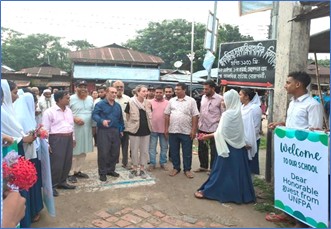
In November 2025, a high-level mission evaluated the field-level impact of interventions focused on adolescent empowerment and healthcare. The mission aimed to verify the effectiveness of gender-transformative activities and inspect newly established infrastructure serving both host communities and displaced populations.
The mission commenced with a dynamic dialogue involving youth volunteers, focusing on community resilience and flood response. This was followed by a multi-sectoral stakeholder meeting with top-tier district officials, including the Deputy Commissioner and Civil Surgeon, to address systemic challenges in health and protection.


